

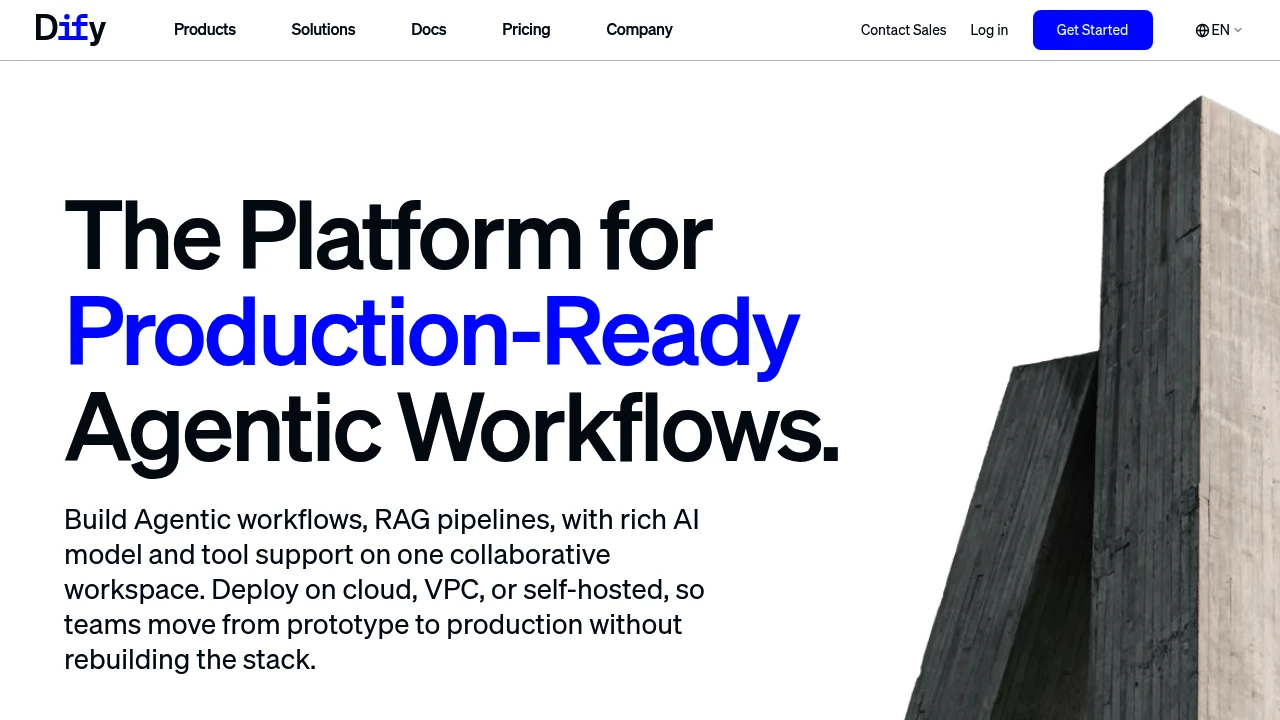
An agent platform connects a model to tools, state, and an execution process. Those connections matter more than a demo that completes one task. Evaluate how the system stores context and handles failed actions.
Predictable workflows or autonomous choices?
Visual builders such as Dify and Langflow help assemble model calls and retrieval steps. n8n connects application events and processing logic. Decide whether the task needs a fixed sequence or a model that chooses its next action. Known steps are often easier to debug as an ordinary workflow.
Inspect the evidence
Use a test set with missing information, ordinary requests, and tool failures. Review intermediate outputs and logs. Check whether a run can resume without repeating external actions. Export a reproducible example outside the platform to keep your workflow portable.
Choose the level of orchestration you need
Dify is a useful starting point when you want to assemble an AI application visually. Langflow is another option to explore for composable model workflows. n8n is relevant when application events and integrations drive the process. The right shortlist depends on whether the model is one step in an automation or the main decision maker.
Sketch your process before installing a platform. Mark the steps that are deterministic, the places that need a model, and the actions that change something outside the system. A document classification workflow may need only one model call. A research assistant may need retrieval, iteration, and human review. Choose the simplest platform that makes that structure inspectable.
Build an evaluation set before a demo
Collect a dozen representative inputs rather than testing with one perfect example. Include a short document, an oversized document, missing fields, contradictory instructions, and an unavailable service. Write the acceptable result for each input in plain language. This gives you a way to compare platforms without depending on the polish of their demonstrations.
Separate output quality from operational behavior. A run can produce a convincing answer while losing its source references or repeating an external action after a retry. Record the trace, the final result, and the recovery behavior. For a workflow that updates another application, use a test environment until you understand how retries are handled.
Budget for the whole workflow
An open repository does not make model inference, databases, monitoring, and hosting free. Estimate the number of model calls per run and the size of retrieved context. A workflow with several reasoning steps can consume more than a single chat request. Keep a small spending limit during the pilot and measure actual usage.
Before rollout, document the workflow configuration, model provider, required secrets, and data stores. Keep credentials outside version control. Export the parts that the platform lets you export and verify that someone else can reconstruct the setup. Portability becomes useful when an integration changes or a platform stops fitting your process.
Before you make the switch
Run a small pilot with your own inputs. Compare the result, setup time, operating effort, and export options. Check current documentation and repository licenses before adopting a project; features and hosted plans can change. Keep the original files and configuration available until your new workflow has been tested.
Official instructions and sources
Official project documentationOriginal AltStack guide by Sushil Kumar Sah. Installation steps follow provider documentation; they do not imply testing on every supported device.